
Ignatian pedagogy is a teaching approach formed in the educational tradition of St. Ignatius of Loyola and Jesuit education. "Jesuit education is a call to human excellence, to the fullest possible development of all human qualities. It is a call to critical thinking and disciplined studies, a call to develop the whole person, head and heart, intellect and feelings" (Fordham, Jesuit Education).
Rather than focusing only on content delivery, Ignatian pedagogy emphasizes the formation of the whole person through five interconnected elements: context, experience, reflection, action, and evaluation. Faculty are encouraged to help students connect learning to their lived experiences, reflect critically on meaning, and apply their knowledge toward service, justice, and personal growth.
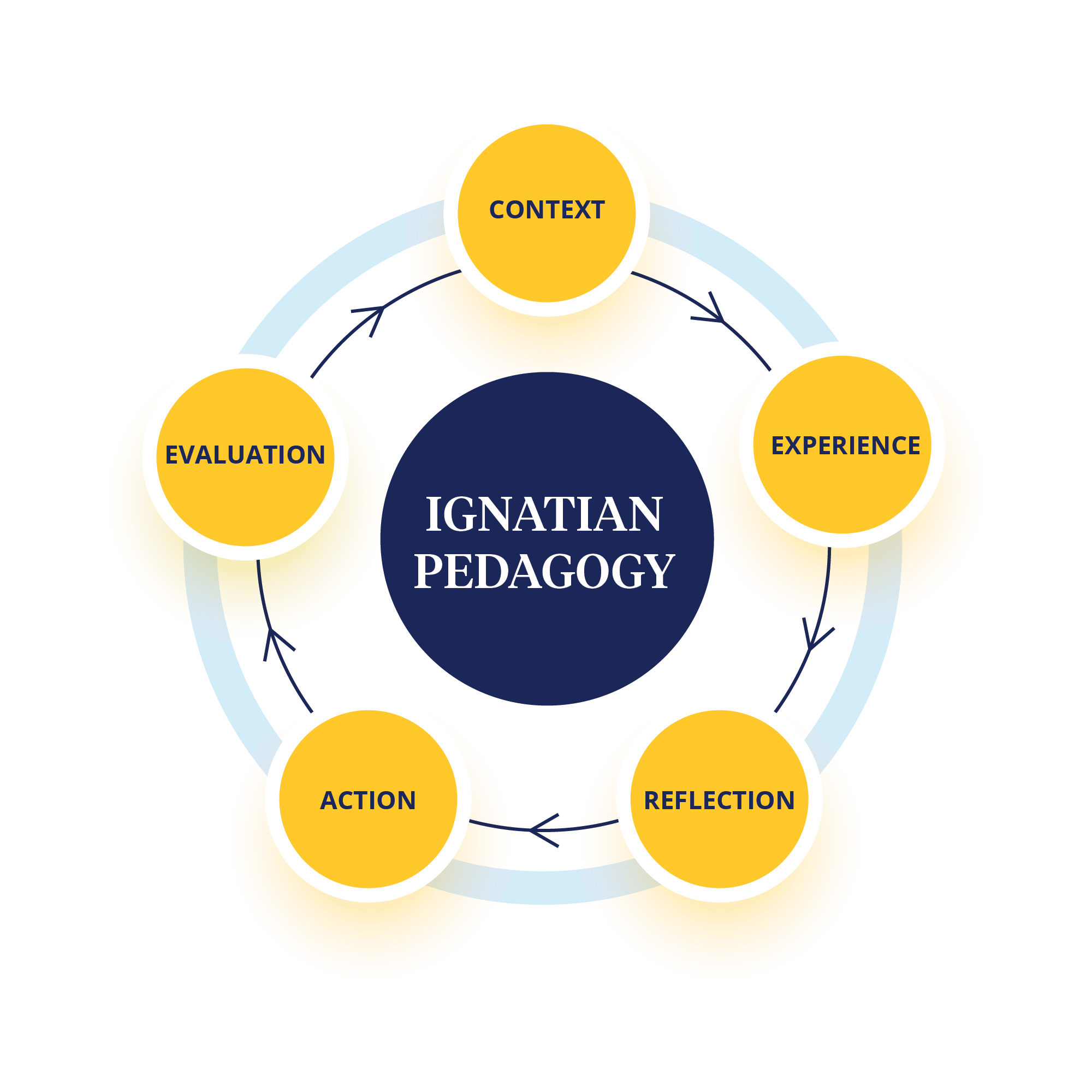
Source: Marquette University, Ignatian Pedagogy Tips for Faculty
Context: Ignatian pedagogy begins with understanding the principle of context for learners - who students are, where they come from, and the social, cultural, economic, and personal realities that shape their learning. Faculty are encouraged to consider students’ prior knowledge, lived experiences, identities, motivations, and challenges before designing instruction.
Experience: The principle of experience invites students into active engagement with ideas, people, texts, communities, and problems. Ignatian pedagogy moves beyond passive reception of information toward experiences that involve intellectual, emotional, and imaginative participation. Effective learning experiences help students connect academic content to their own values and emerging sense of purpose (Marquette University).
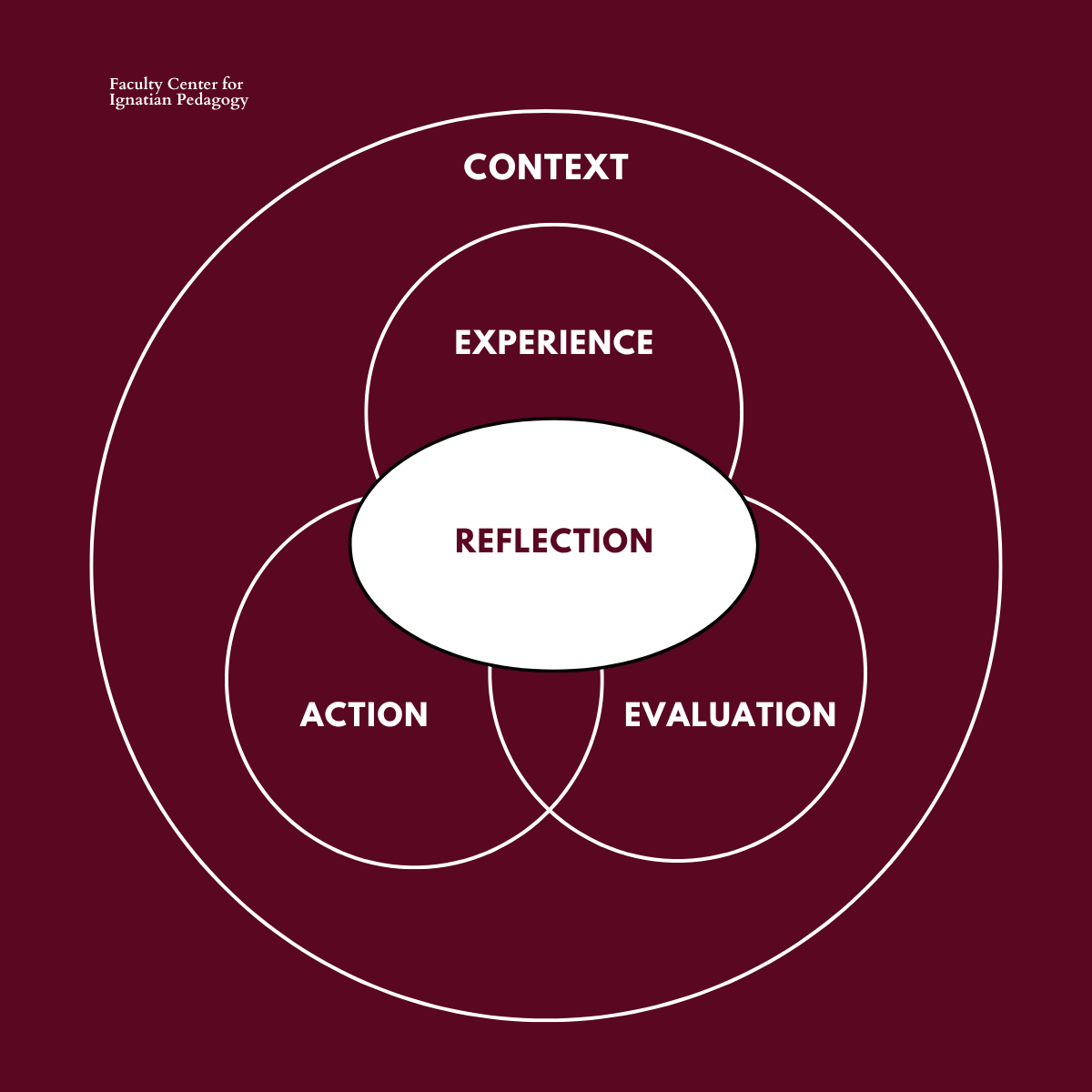
Reflection: Through the principle of reflection, students consider the meaning and implications of what they have learned and experienced. Reflection encourages learners to ask deeper questions: Why does this matter? How has this changed my understanding? What responsibilities emerge from this knowledge? Reflection may occur through writing, dialogue, contemplative exercises, discussion, or guided questioning. Loyola University Chicago considers "reflection" the glue that holds the other principles together.
Action: In Ignatian pedagogy, reflection naturally leads to the principle of action. Students are encouraged to apply what they learn in ways that promote growth, justice, service, and responsible engagement with the world. Action may involve civic engagement, ethical decision-making, advocacy, leadership, professional practice, or changes in personal perspective and behavior. The goal is not simply knowledge acquisition, but transformation that moves learners toward becoming “persons for others" (see Xavier University Jesuit Resources).
Evaluation: Ignatian evaluation extends beyond exams and grades to include students’ development in critical thinking, self-awareness, ethical reasoning, and engagement with others. The principle of evaluation encourages faculty to use assessment practices that help students recognize their progress, identify areas for growth, and continue the cycle of learning and reflection.
What does this have to do with you as a faculty member at Loyola University New Orleans? Consider this statement from St. Louis University: "Every faculty member at a Jesuit institution finds her own way to connect to her university's particular mission. Whether or not this connection is rooted in shared religious belief, it is at least minimally connected to the Jesuit commitment to the transformational power of education. This commitment manifests itself in various ways, from community-based service learning to addressing social justice issues in the classroom to cura personalis (Latin for "care of the whole person") in our dealings with students."
Loyola Week 2026: Resources for You and Your Classes
Loyola Week this year takes place October 18-24. The Center for Teaching, Research, and Learning invites you and the Office of Mission & Identity invite you to 1) learn more about the Ignatian spirituality that undergirds Loyola’s mission and 2) integrate some element of Loyola’s Jesuit and Catholic mission into your classes that week. Below are some resources.
For you:
Drop by the Marquette Hall Room 200 to pick up from Emily Lousteau Bourgeois a copy of former Loyola Professor Gerald M. Fagin, S.J.’s Discovering Your Dream: How Ignatian Spirituality Can Guide Your Life.
For Your Classes:
- View and discuss a light but informative video “The Story of St. Ignatius as Told by an Olive.”
- Browse past issues of Conversations on Jesuit Higher Education for articles that fit the subject of your classes. Here are some examples of articles you’d find:
- Erin Brigham and Catherine Punsalan-Manlimos, “Research as a Spiritual Practice: An Ignatian Approach.”
- Mary Ann McDonald Carolan, “AI and Dante: Circling Hell Anew.”
- Peter Nguyen, S.J., “The Hopeful Death of Alfred Delp, S.J.: Self-emptying in a Time of Darkness.”
- Linda LeMura, “Why Spend on Athletics?: Because It’s Part of the Jesuit Mission.”
- Pat Bourgeois, “Marketing for Mission: Can Jesuit Education Be ‘Branded’?”
- Richard P. Dober, “Heritage, Identity and Campus Design.”
- Barbara J. Busse, “Just Listen: Jesuit Higher Education and the Situation of Women.”
- Marcus Mescher, “Moral Injury and the Hope of Reconciliation.”
- For longer research articles, browse, Jesuit Higher Education: A Journal. Here are examples of articles you’ll find:
- Nicole Reibe, “Generative AI and the Ignatian Pedagogical Paradigm.”
- Julia A. Dowd, “Otra historia ignaciana: incluyendo a las mujeres en la historia de la misión jesuita.”
- Enaya Hammad Othman, “Ignatian Values and International Conference on Disability.”
- Other items to consider:
- Si Hendry, S.J., The Jesuit Mission in Higher Education. Loyola University New Orleans.
- Thomas M. King, “Research as Adoration: Pierre Teilhard de Chardin, S.J.” The Way vol. 44, no. 3, 2005.
- Chris Lowney, “Lessons in Leadership.” Health Progress, vol. 89, no. 2, 2008. Based on his Heroic Leadership: Best Practices from a 450-Year-Old Company [the Jesuits] that Changed the World. Loyola Press, 2005.
- Other Resources
- Feedback.
- If you do integrate some aspect of Loyola’s Jesuit and/or Catholic mission into your class, we’d love to hear how it went. If you get a chance, please complete this brief and optional survey.
1. St. Louis University YouTube Video, "The Ignatian Pedagogical Paradigm"
2. Xavier University has a compendium of "Teaching to the Mission" resources by discipline with examples from their classes.
3. Father James Martin (2016, American Jesuit Review), "What's so Great About Jesuit Education?"